
Let me take you on an exciting journey through the Dutch football pyramid with our newly formed club, “Division FC.” In this article, I’ll walk you through exactly how our ambitious new team can climb the ranks, explore every possible route to Eredivisie promotion, and break down the financial rewards that come with a successful campaign through the Dutch football system.
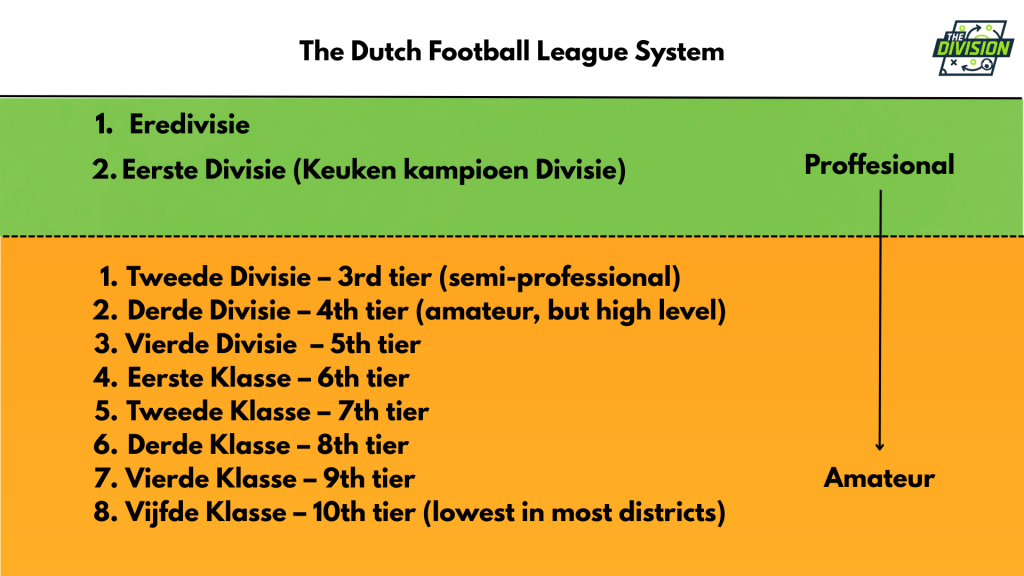
Our adventure begins at the bottom of the Dutch football pyramid – the 10th tier, better known as the Vijfde Klasse. Getting “Division FC” out of the Vijfde Klasse and into the Vierde Divisie is straightforward enough: win matches, earn promotion. Simple in concept, though certainly not easy in execution – but at least the path is crystal clear.
However, once we’ve established ourselves in the Vierde Divisie, our journey to the Eerste Divisie becomes much more complex. Success here isn’t just about what happens on the pitch – it’s fundamentally about our financial resources and meeting strict professional standards. If we can secure the funding and satisfy these key requirements, the leap to Eerste Divisie becomes possible. We Need the following to be deemed as a professional team:
KNVB Professional License
- A club must obtain a Category A license from the KNVB to play professional football.
- This covers finances, organization, facilities, and youth development.
Stadium requirements
- Minimum capacity (around 3,000 seats is expected for Eerste Divisie, though exceptions exist).
- Proper safety measures, floodlights, media facilities, VIP & press areas, separate stands for away fans, etc.
Financial stability
- Clubs must prove they can operate professionally (player/staff contracts, no major debts, solid budget).
- KNVB monitors clubs through its licensing system (clubs can be punished if finances collapse).
Youth academy
- Professional clubs are expected to run a structured youth academy under KNVB standards.
- This is part of the license requirement.
Full professional staff
- Must employ licensed coaches, medical staff, and administrative staff.
- Players need to have professional contracts, not just amateur agreements.
After many years of hard work and a lot of money spend, we have arranged to Mission accomplished – we’ve ticked every box and secured our spot in the Eerste Divisie (Keuken Kampioen Divisie)! “Division FC” has officially joined the ranks of Dutch professional football, but this is just another stepping stone in our larger vision. The hunger for continued growth burns strong, though the road ahead presents our toughest challenge yet.
The Keuken Kampioen Divisie houses 20 professional teams, but there’s a crucial detail that changes everything – not all of these clubs are genuinely pursuing promotion. Mixed into the league are teams like Jong Ajax, Jong PSV, and Jong AZ – the youth and reserve sides of Eredivsies biggest clubs. These “jong” teams operate under a strict rule: they cannot play in the same league as their senior counterparts. This effectively traps them in the Keuken Kampioen Divisie indefinitely, unless their parent club suffers relegation from the Eredivisie or they themselves get relegated.
Given this landscape, what pathways exist for “Division FC” to reach the promised land of the Eredivisie?
- The Championship Route: Top the table to earn automatic promotion. Straightforward and stress-free.
- The Playoff Battle: The league features a playoff system that puts a distinctly Dutch spin on promotion battles. The 2nd and 3rd place finishers enter the playoffs as expected, but they’re joined by something special – the bottom two Eredivisie teams (16th and 17th place) who must defend their elite status.
To complete this playoff structure, four more teams are needed, and their qualification follows these specific criteria:
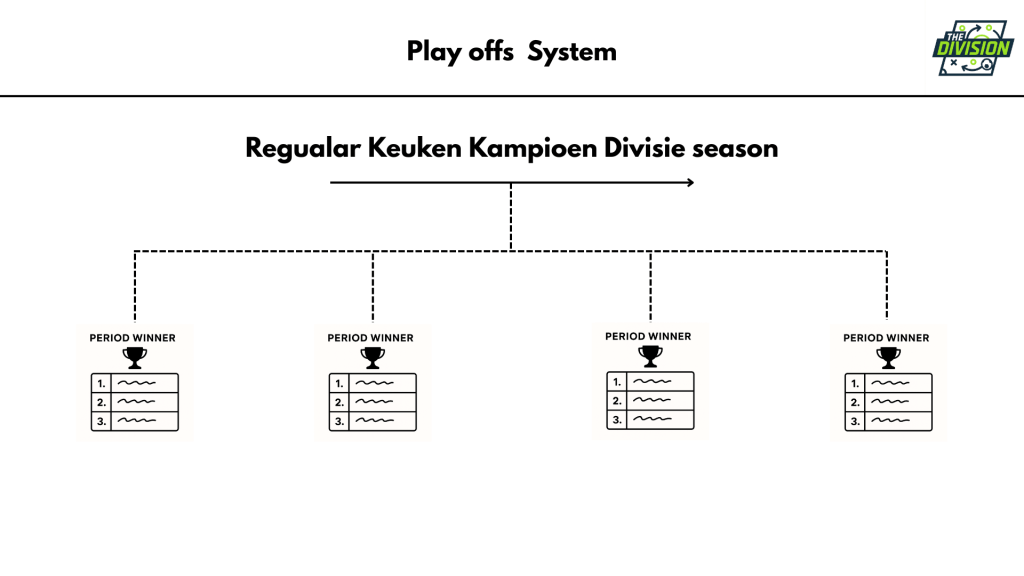
Here’s where the Dutch system gets truly creative – the league operates a unique “Period” system that runs alongside the main championship. The season is divided into 4 distinct periods, each spanning roughly 9 to 10 matches. Win your period, and you’ve earned yourself a playoff spot, regardless of your overall league position.
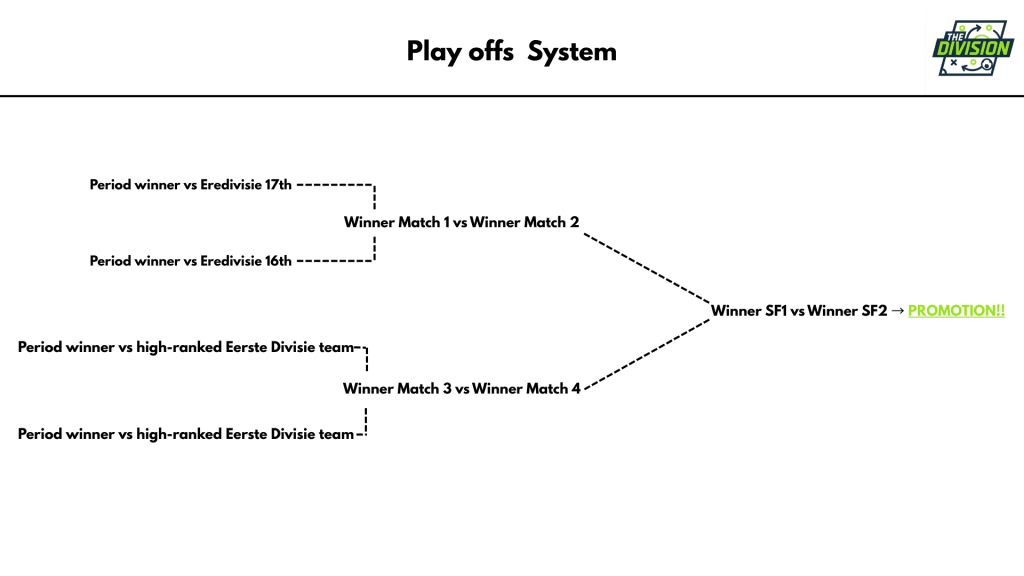
This creates some absolutely wild scenarios. Picture this: a team could theoretically go on an incredible hot streak, winning all 9-10 games in just one period, then completely fall apart for the rest of the season. As long as they avoid relegation, that single period victory still guarantees them a playoff place and a legitimate shot at Eredivisie promotion. It’s a system that rewards short-term excellence and keeps hope alive for teams throughout the entire campaign.

Now after a few years: Success! “Division FC” has finally reached the pinnacle – we’re now competing in the Eredivisie! But beyond the prestige and glory, what does this promotion mean for our bank account? The financial transformation that comes with Eredivisie promotion is – I would say – lacking.
The Eredivisie’s television deal brings in approximately €150 million annually. Once the KNVB covers administrative expenses and UEFA obligations, roughly €80–100 million remains for distribution among the 18 clubs. While the split certainly isn’t equal – powerhouses like Ajax and Feyenoord claim the lion’s share as they usually end up in the top part of the table. Teams at the lower end make a fraction of the €80-100 million.
Television revenue is just the beginning. Eredivisie status unlocks higher attendance figures, premium ticket pricing, more attractive sponsorship deals, and increased merchandise sales. When you combine all these revenue streams, a newly promoted club can realistically anticipate an additional €3–7 million during their debut top-flight campaign.
While these figures might sound impressive on paper, the reality in modern football is quite sobering. This influx of cash, though significant for the club, doesn’t go nearly as far as you might expect. The majority of these newfound millions get immediately absorbed by essential infrastructure investments – upgraded facilities, improved training grounds, enhanced youth academies, and meeting the higher operational standards required at Eredivisie level. What remains for actual player acquisitions is often disappointingly modest, which creates a real challenge for newly promoted clubs trying to build a squad capable of competing with established Eredivisie teams.
Take Telstar as a perfect case study this season. Through their first 6 matches, they’re sitting in a worrying 17th position with just 4 points on the board. While there’s still plenty of football left to play, early signs suggest they’re finding it difficult to adapt to the Eredivisie’s intensity and quality. However, promotion struggles aren’t universal – fellow newcomers FC Volendam tell a completely different story, currently holding a respectable 12th place. These contrasting fortunes show that while the step up is undeniably challenging, it’s not impossible. Of course, we’ll need to wait until the end of the season to see which team handled the summer most effectively.
This is the reality that newly promoted clubs face – a constant balancing act between immediate survival and long-term sustainability. The clubs that master this balance write the success stories, while those that don’t often find themselves back in the Keuken Kampioen Divisie within a year or two.
But our story with “Division FC” doesn’t end with mere Eredivisie survival. What about European football? What about competing with Ajax and PSV on the continental stage? These dreams aren’t impossible, but they require understanding an entirely different set of challenges – coefficient rankings, UEFA regulations, and the financial demands of European competition.
That’s exactly what we’ll be exploring in our next article. How does a club transition from Eredivisie newcomer to European contender? What are the financial implications of continental football? And how does the Netherlands’ coefficient ranking affect every club’s European ambitions?
The Dutch football pyramid has shown us one thing clearly: with enough determination, strategic thinking, and yes, significant investment, remarkable journeys are possible. “Division FC” may have started as a hypothetical example, but clubs like RKC Waalwijk, and others have proven that these dreams can become reality.
Thanks for following along on this exploration of Dutch football’s fascinating structure. See you next time as we continue climbing toward European glory!
Groetjes (Greetings)
The Division.
 The Division
Leave a comment