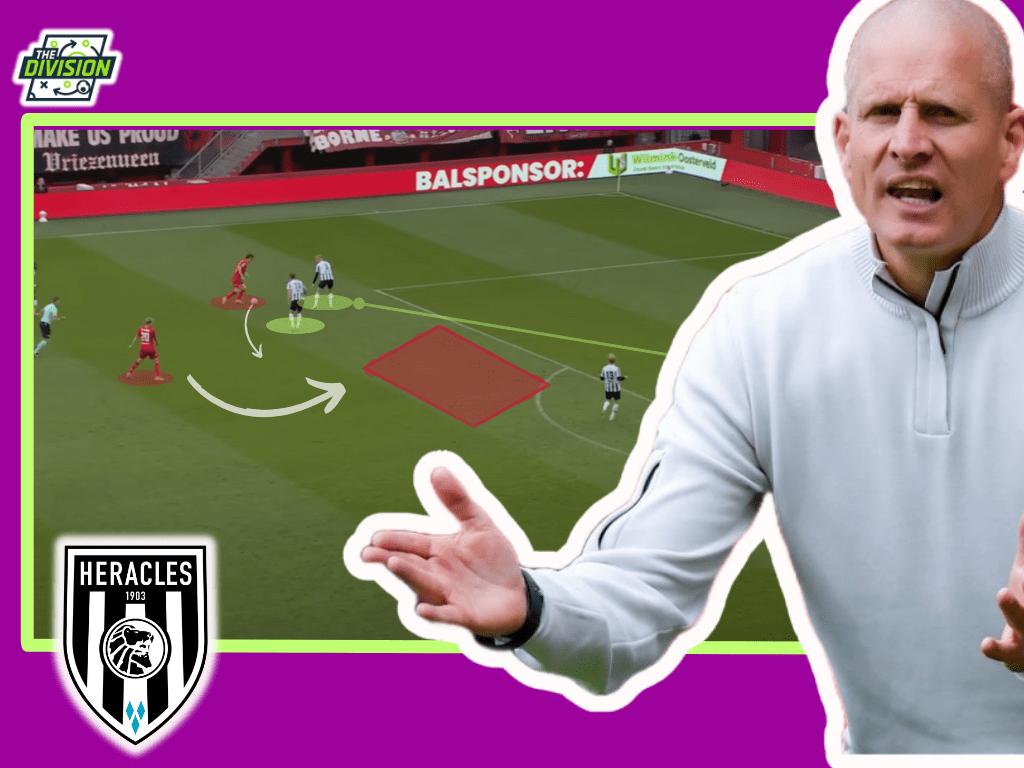
Eight games into the Eredivisie season, Heracles Almelo find themselves in deep trouble. Bottom of the table in 18th place, with 20 goals conceded, just 7 scored, and only one win to their name — the numbers paint a grim picture.
It’s a sharp decline from last season. In 2024/25, Heracles finished 14th, losing 14 matches across the entire campaign. Yet this year, they have already lost seven — half as many defeats in less than a quarter of the games. The question naturally arises: what went wrong?
The answer lies in three key areas:
- The new tactical approach introduced by Bas Sibum
- The loss of a key player who shaped Heracles’ balance
- The mindset and confidence of the squad
Before diving into these factors, it’s important to understand how Sibum — a familiar face at Erve Asito (Heracles Almelo Stadium) — ended up in the Heracles dugout.
From Van de Looi to Sibum: A Change in Direction
The 2024/25 season was guided by Erwin van de Looi, who managed to keep Heracles afloat in 14th place. On paper, it was a modest but stable season — yet behind the scenes, tensions were brewing. Towards the end of the campaign, Van de Looi made a revealing statement:
“I’ve really enjoyed working with the players, and I’ve also been positive about the club and the facilities. But I haven’t been satisfied with the cooperation at other levels within the organization. At that point, you have two choices: either accept it or move on. For me, it’s become the latter.”
Van de Looi’s comments hinted at deeper structural issues within the club — differences in vision or communication between the technical staff and management. His departure left Heracles searching for a coach who would not only fit their sporting ambitions but also align with the club’s internal culture.
Their choice fell on Bas Sibum, a familiar name in Almelo.
“With Bas, we are bringing in someone who knows the club,” explained technical director Nico-Jan Hoogma upon his appointment.
Sibum, a former defensive midfielder with over 350 professional appearances, built his reputation at FC Twente, NEC Nijmegen, and Heracles Almelo itself. The board’s logic was clear: by bringing in someone who understood the DNA of the club, they hoped to restore unity and stability after a turbulent period.
Before returning to Almelo, Sibum had impressed as manager of Roda JC in the Eerste Divisie. Appointed in May 2023, he took charge of a side languishing in 15th place and transformed them into genuine promotion contenders within a year. His high-intensity style, tactical organization, and strong dressing-room presence made Roda one of the division’s most balanced teams.
By the end of the 2023/24 campaign, Roda finished third with 75 points — 21 wins, 12 draws, and only 5 losses — the club’s best season in years. Though promotion ultimately slipped away after a playoff defeat to NAC Breda, Sibum’s turnaround earned him the Eerste Divisie Manager of the Season award. His side combined defensive solidity with attacking energy, and midfielders Walid Ould-Chikh and Enrique Peña Zauner ended joint top scorers with 12 goals each.
Sibum began the following season still at Roda, but results dipped slightly as the team settled into mid-table form. Nonetheless, his overall body of work stood out — he had rejuvenated a struggling club and built a clear identity. That success made him an attractive candidate for Eredivisie sides looking for a young, ambitious coach — and Heracles answered the call.
1. The New Tactics Employed by Bas Sibum
Bas Sibum sets up his Heracles side in a 4-2-3-1, aiming to implement an aggressive, front-foot style. His intention is clear: press high, win the ball early, and take the game to the opposition.
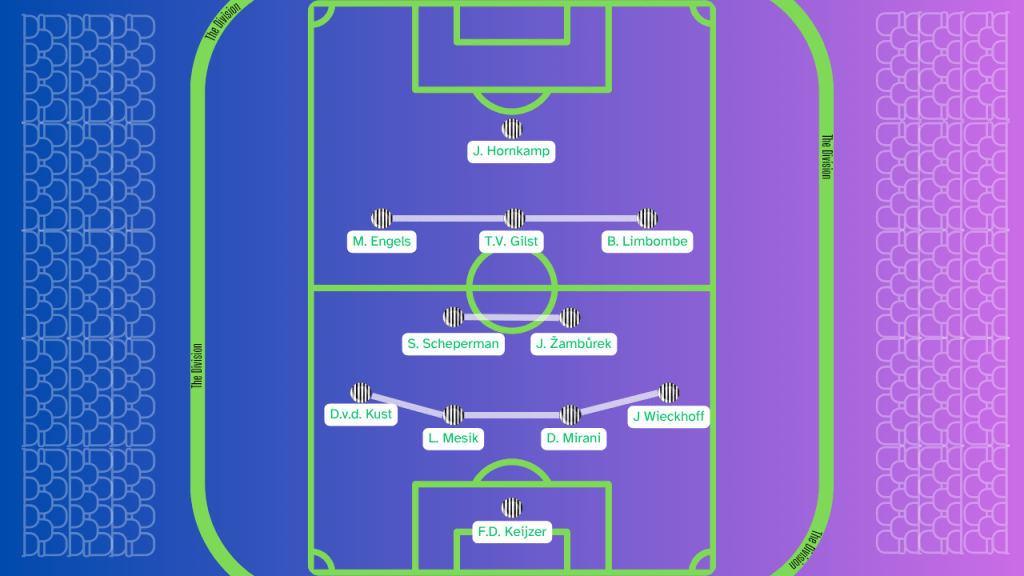
However, this attacking mindset proved too ambitious for the current squad. Eight games into the season, Heracles’ defensive fragility has been exposed — most notably in the first four matches, where the system’s flaws were most evident.
They conceded 14 goals in their opening four games, compared to just six in the next four — a clear sign that the initial tactical approach left them far too open.
The root cause lies in the structure of the press. Sibum instructed his players to press high and aggressively, but the team’s execution often lacked cohesion and balance.
Let’s break this down with an example.
In one instance, Heracles pressed high as the opposition goalkeeper (Groningen) had possession. Hornkamp and Hrustic — playing as the striker and attacking midfielder — pushed forward to close down the centre-backs. Meanwhile, Groningen’s two pivot midfielders remained unmarked and freely available to receive the ball.

When the goalkeeper played into one of the pivots and got the ball back, Gilst (the left winger) and Scheperman (the holding midfielder) also pushed up to join the press. The issue? Scheperman, normally the shield in front of the defence, advanced so far that he became the most advanced player on the pitch.
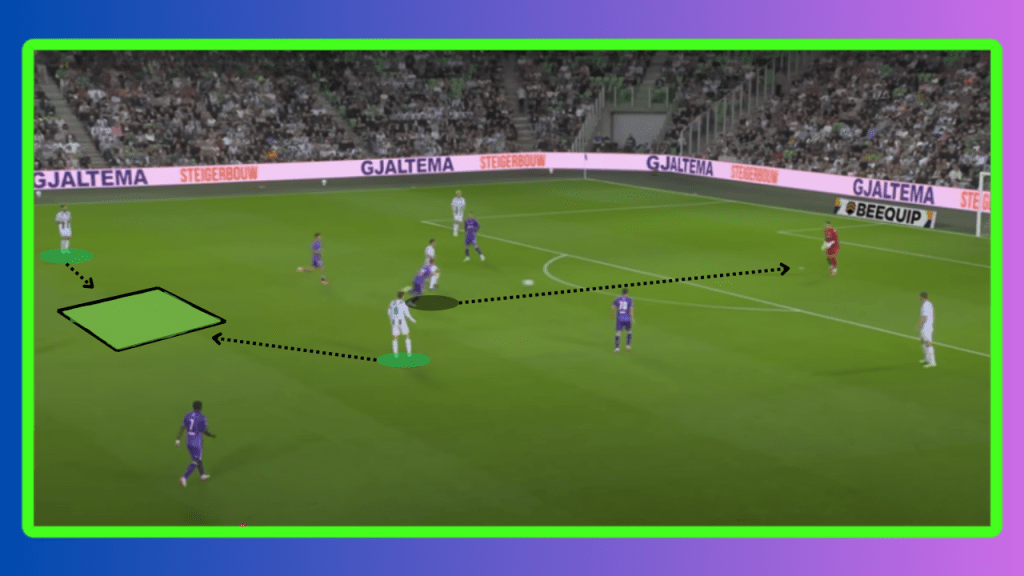
Limbombe, the right winger, held his wide position — leaving a huge gap through the middle of the pitch. When Groningen quickly transitioned, Heracles were left with just Žambůrek trying to contain the central zone, far too isolated to prevent progression.
This moment perfectly illustrates the problem: Heracles’ press lacked structure and triggers. The players pressed individually rather than collectively, leaving open lanes and no cover behind.
At the elite level — even acknowledging that the Eredivisie isn’t the Premier League — a high press must either force the opponent long or trap them into mistakes. Instead, Heracles’ disjointed pressing repeatedly opened up spaces, leading directly to goals conceded.
In those first four games, this pattern was consistent: the press broke down easily, the team was caught high up the pitch, and their rest defense — the players left behind to handle transitions — was repeatedly exposed. As a result, Heracles conceded 14 goals in the opening four matches before eventually tightening up in the following weeks.
2. The Loss of a Key Player: Brian De Keersmaecker
he second major change for Heracles came with the departure of their midfield leader, Brian De Keersmaecker. He left the club at the end of the 2024/25 season to join Oxford United for an undisclosed fee — reportedly between €1 million and €3 million. Considering Heracles had signed him for just €400,000 in 2023, it was strong business financially.
But on the pitch, it left a huge void.
De Keersmaecker wasn’t just a captain-type presence — he was the defensive heartbeat of the side. His exit disrupted both the team’s balance and its leadership structure.
According to FBref, De Keersmaecker’s 2024/25 metrics underline the type of player he was: a blend of defensive solidity and progressive playmaking. He consistently ranked among the team’s best for tackles, blocks, interceptions, and progressive passes, giving Heracles security in possession and stability without the ball.
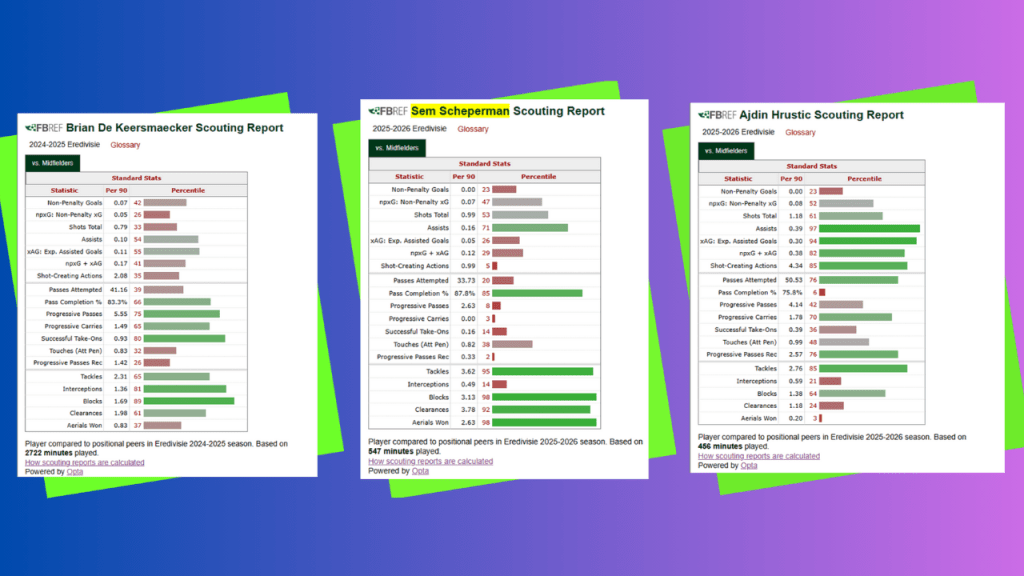
Together with Sven Scheperman, he formed a reliable double pivot that shielded the defence and helped the club finish 14th — comfortably above the relegation zone.
His replacement this season, Ajdin Hrustic, is a different profile altogether.
FBref data suggests Hrustic is far more attack-minded, thriving in advanced roles rather than as a defensive anchor. While he has tried to match De Keersmaecker’s defensive work rate in terms of tackles per 90, his interceptions per 90 are considerably lower — indicating that he doesn’t read opposition buildup as effectively or occupy the same defensive positions.
This drop in defensive anticipation has affected Heracles’ ability to handle transitions. Where De Keersmaecker often broke up play before danger developed, Hrustic’s instincts push him forward, leaving spaces behind.
That said, the season is still young. With time, Hrustic may adapt to the role and grow into Sibum’s system — but as it stands, Heracles have yet to replace the defensive intelligence and leadership De Keersmaecker once provided.
3. The Mindset and Defensive Awareness of the Players
The third issue Heracles face lies in defensive awareness and decision-making — moments where concentration lapses or positional errors undo otherwise solid tactical intentions.
Let’s look at a few examples.
Example 1: Utrecht’s opening goal
This sequence began with Heracles attempting to hit Utrecht on the counter. However, a misplaced pass turned possession over, and the ball quickly fell to Utrecht’s centre-back.
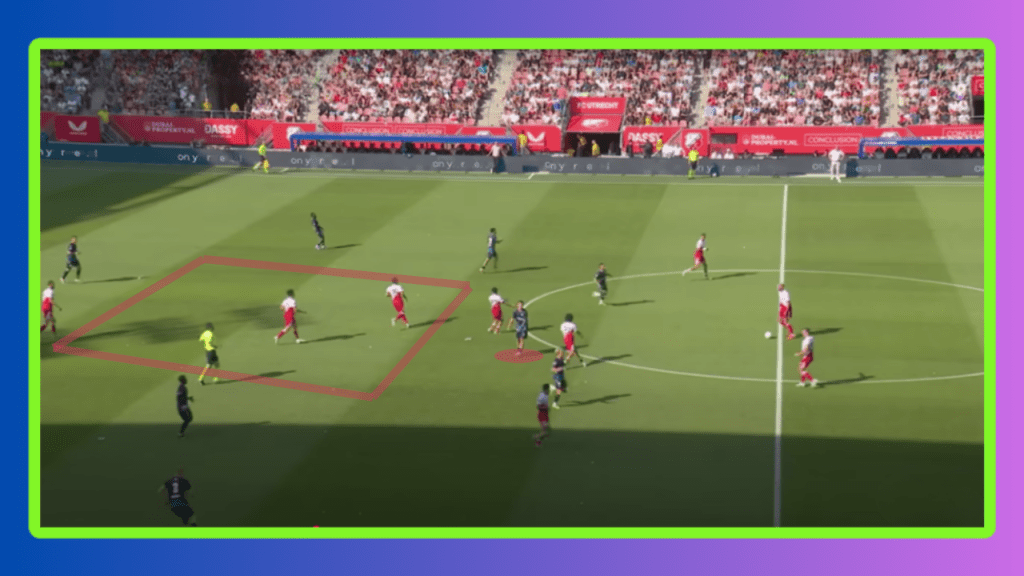
Two major mistakes followed:
- Lack of reaction from the forwards
As Johan Cruyff famously said, “In my teams, the goalkeeper is the first attacker, and the striker is the first defender.”
Even though Sibum’s side doesn’t play a Cruyffian style, modern football still demands that every player contributes defensively. In this case, Hornkamp switched off after losing possession, visibly frustrated, and failed to cut the passing lane into midfield. That one moment allowed Utrecht to reset their attack comfortably. - Poor rest defense structure
With Žambůrek pushed high and Scheperman still sitting deep among the centre-backs, a large gap opened up in midfield. This exposed Heracles’ rest defense — the defensive shape a team maintains during attack to protect against transitions.

When Utrecht regained the ball, Scheperman rushed up to close the space, but in a 2v1 situation he was easily bypassed. The back four were left extremely narrow, and both Limbombe and Wieckhoff were caught ball-watching. This allowed Utrecht’s wide attacker on the left to remain completely free.
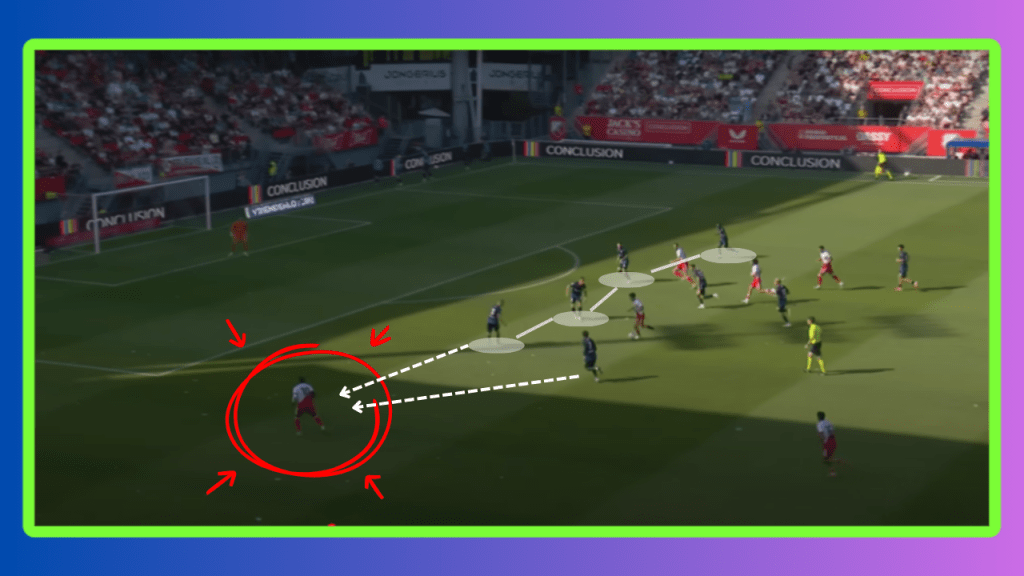
Neither player adjusted:
- Wieckhoff could have shifted wide to close the winger.
- Limbombe could have tracked back deeper to cover the space.
Instead, Utrecht were given time and space to deliver a cross, which led directly to the opening goal.
This sequence highlights a recurring theme: Heracles’ players often react after danger develops, rather than anticipating it — a hallmark of poor defensive awareness and communication.
Example 2: Twente’s second goal (2–1 defeat)
A similar issue appeared in the recent loss to Twente. The danger again came from the flanks. The ball was played down the left, where Wieckhoff and Hrustic found themselves in a 2v1 situation.

At first glance, doubling up seemed logical. But in doing so, Hrustic — Heracles’ defensive midfielder — vacated the central area, leaving a gaping hole in front of the box. Twente exploited it perfectly: a simple cutback found the free man in the middle, who had time to set himself and score with a placed shot.
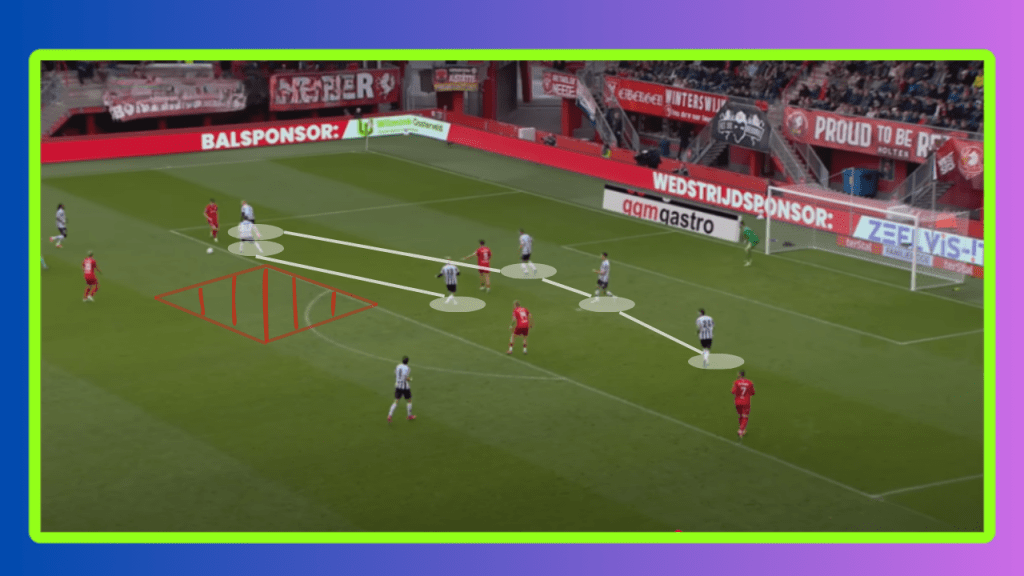
The intention was understandable — protect the wing — but the execution was poor. Football, especially in defensive transition, is a numbers game: if one player moves to help, another must cover his space. That didn’t happen here.
How these issues could be prevented
There are several ways Sibum’s side could handle such situations more effectively:
- Individual discipline – Full-backs like Wieckhoff should trust their 1v1 defending and guide wingers toward the corner flag, rather than relying on midfield cover too early.
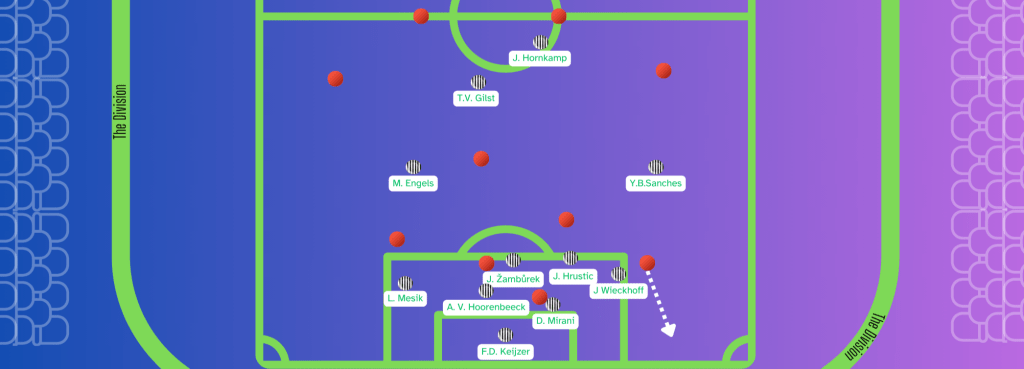
- Collective balance – If full-back support is essential, then:
- The winger (Sacnhes, for instance) must track back to create a temporary 2v1.
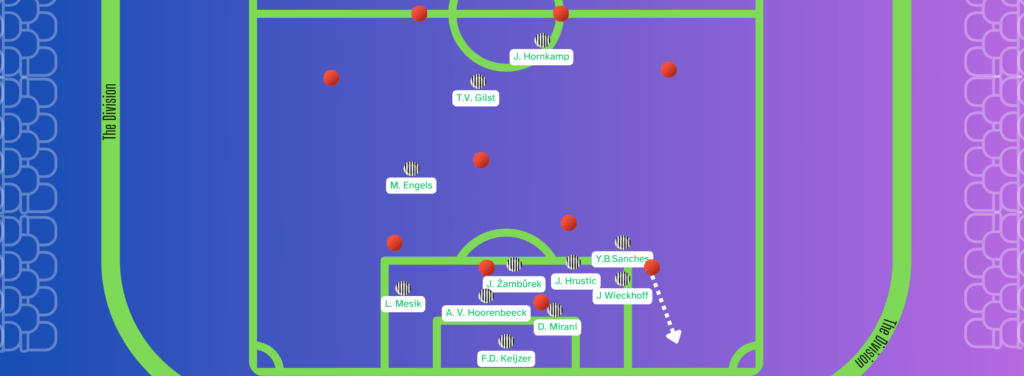
- Or, Sibum could instruct the team to drop into a 4-3-3 defensive shape, allowing the right and left central midfielders to drift wide when needed, while keeping two others shielding the box.
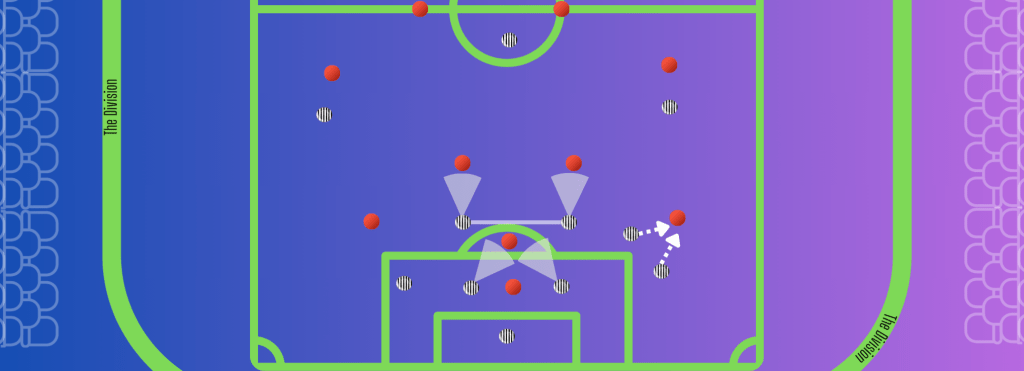
Adjustments and improvements
These defensive lapses largely explain Heracles’ chaotic start — 14 goals conceded in the first four matches. However, Sibum has since adapted. In the next four games, he made both personnel and tactical adjustments:
- Borges, known for his ability to progress the ball under pressure, was introduced.
- Benita, a more composed and positionally aware right-back than Wieckhoff, also came into the lineup.
- Against Sparta Rotterdam, Sibum even experimented with a 4-4-2, which provided better balance and resulted in a convincing 3–0 victory.
These tweaks suggest Sibum has learned from the early setbacks — tightening the rest defense, improving spacing, and reintroducing compactness between lines.
Conclusion
Eight matches into the season — is Heracles doomed?
At the moment, the signs aren’t encouraging. While Bas Sibum has managed to make small adjustments that reduced the number of goals conceded, the team still struggles both to create chances and to defend collectively.
The real solution lies in the mindset of both Sibum and his players. Hopefully, after eight games, Sibum recognizes that the current 4-2-3-1 setup may not suit this squad. To build greater defensive stability, a switch to a 4-3-3 could offer more protection through the middle, or as seen in the 3-0 win over Sparta, a 4-4-2 provides a compact, solid defensive block that’s harder to break down.
With players like Borges and Limbombe capable of carrying the ball forward, and Hornkamp offering finishing ability, Heracles might be better served by focusing on attacking transitions — sitting compact and striking quickly — rather than trying to control possession.
However, the burden doesn’t fall solely on Sibum. The players must also take responsibility. They need to defend as a unit, stop ball-watching, and show the work rate required to compete at Eredivisie level. As the saying goes, defending starts from the striker.
The wingers and midfielders, in particular, must cover more ground — both in pressing and recovery. To put it in perspective: Telstar, newly promoted from the Eerste Divisie and currently sitting 14th, have four players among the top 20 in distance covered this season. Their success is built on collective effort — every player contributes to both attack and defence.
For Heracles to survive, they’ll need that same mentality. Tactical tweaks can help, but without commitment, intensity, and unity, even the best system will fail. The road ahead is difficult — but with the right adjustments and a renewed mindset, there’s still time for Sibum’s Heracles to turn things around.
 The Division
Leave a comment