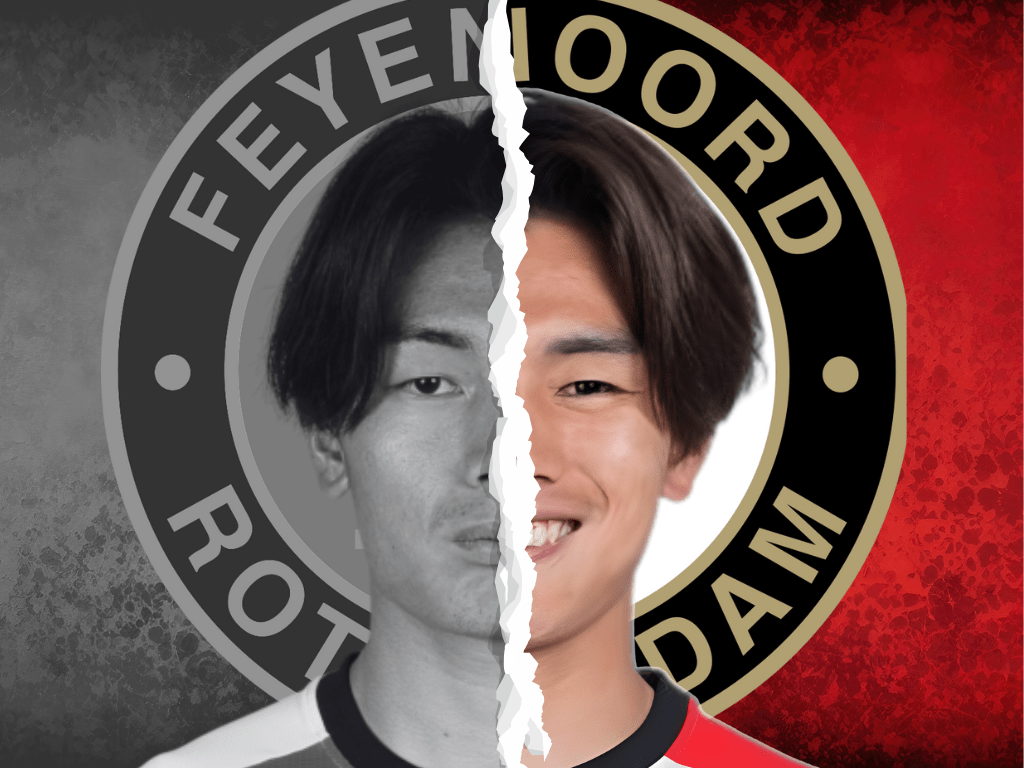
How the Japanese striker transformed from a €9 million question mark to the Eredivisie’s most clinical finisher
Few stories in European football this season have been as quietly remarkable as Ayase Ueda’s rebirth at Feyenoord. Once considered an expensive gamble after a muted first year in Rotterdam, the Japanese striker has erupted into life in the 2025/26 campaign. 11 goals in his first nine Eredivisie matches have fired Feyenoord to the top of the table and silenced any lingering doubts about his quality.
But how did a player who struggled for rhythm and consistency just a season ago suddenly become the league’s most efficient striker? The answer lies in tactical refinement, physical transformation, and a resurgence of confidence that perfectly align with Robin van Persie’s attacking philosophy.
Who Is Ayase Ueda?
Born in Mito, Ibaraki, Japan, Ayase Ueda’s rise has been steady rather than meteoric. He honed his craft at Hosei University before joining Kashima Antlers in 2019. There, his sharp movement and instinctive finishing quickly made him one of the J-League’s standout forwards, consistently hitting double figures each season.
European scouts soon took notice. In 2022, Belgian side Cercle Brugge swooped in, paying roughly €1.5 million for the then-24-year-old. Ueda repaid their faith spectacularly—bagging 22 goals and 2 assists in his debut campaign in the Belgian Pro League.
Feyenoord, freshly crowned Eredivisie champions and in need of attacking depth, came calling in the summer of 2023. They paid around €9 million—a record deal for the Brugge side and a major step up for Ueda. On paper, it looked a masterstroke. In practice, however, the adaptation period was rocky.

During his debut 2023/24 season, Ueda managed only 5 goals and 2 assists, mostly coming off the bench behind Santiago Giménez. Critics questioned whether Feyenoord had overspent. Yet football, as it often does, rewards patience.
A Slow Burn: 2024/25 Frustrations
Ueda’s second year in Rotterdam, the 2024/25 campaign, coincided with significant upheaval. Arne Slot’s departure to Liverpool ended a successful era, and new management brought tactical tweaks that didn’t initially suit Ueda’s rhythm.
Across the league season, he scored 7 goals from an expected goals (xG) of 7.24, playing just 1,210 minutes—averaging a goal every 173 minutes. Respectable, but not enough to cement a starting berth for a club chasing silverware.
The data painted a clear picture: Ueda needed consistency. Of the 20 goals he had scored in all competitions since joining Feyenoord up to that point, only three came as a substitute. When starting, he thrived; when benched, he faded. The conclusion was simple—give him rhythm, and he’ll repay it in goals.
2025/26: The Ueda Renaissance
Tactical Transformation Under Van Persie
The arrival of Robin van Persie as head coach midway through 2024/25 marked the true beginning of Ueda’s renaissance. A striker of elite pedigree himself, Van Persie understood what Ueda needed—clarity, confidence, and a defined role.
This season, Ueda has become the undisputed No. 9. With Giménez’s departure to Italy, Van Persie rebuilt the attack around the Japanese forward, maintaining Feyenoord’s lone-striker system but adjusting it to emphasize vertical runs and quicker link-up play.
Van Persie’s footballing philosophy—“met lef, intensiteit en strijd” (“with guts, intensity, and fight”)—demands relentless pressing and dynamic attacking transitions. Ueda, once seen as too measured for the Dutch tempo, has adapted brilliantly.
The coaching staff, including assistant René Hake, worked meticulously on his positional awareness. One example stands out: a headed goal against FC Groningen where Ueda feinted to the back post before darting near-side to meet the cross. Van Persie later revealed that this precise movement had been drilled for weeks on the training pitch.
“He’s been finding space brilliantly for weeks,” Van Persie told Dutch media. “Now he’s converting those opportunities.”
This positional intelligence, combined with fluid service from Anis Hadj Moussa, Leo Sauer, and attacking full-backs like Jordan Bos, has turned Feyenoord into a creative machine. Ueda is now the spearhead of a system that constantly feeds him the ball in dangerous zones.
Pressing From the Front
One of the criticisms levelled at Ueda under Slot was his reluctance—or inability—to lead the press effectively. That narrative has been completely rewritten.
During pre-season, Van Persie implemented a brutal training regimen emphasizing defensive work. “He had to work extremely hard, especially in the first weeks,” the coach recalled. “He covered so many meters—you have no idea!”
Ueda’s transformation was immediate. He now initiates the high press, setting the tone for Feyenoord’s defensive structure. His improved fitness allows him to harass defenders deep into stoppage time, forcing turnovers that often lead directly to chances.
That relentless energy was on full display against FC Utrecht, where he chased lost causes until the 90th minute—then popped up to score the winner, completing a brace in a thrilling 3–2 victory.
Peak Physical Form
A major reason behind Ueda’s sharpness this season is his clean bill of health. In late 2024, he suffered a hamstring injury against Ajax that sidelined him for months. Slot once lamented, “If Ueda can train for three months straight, he’ll be a really good striker.”
Van Persie ensured that prophecy came true. The striker’s first full, injury-free pre-season in the Netherlands transformed his physique. Teammates describe him as leaner, quicker, and far more explosive. Van Persie even joked that Ueda trained “like a madman.”
The result is a striker who can play full 90-minute shifts without fading—a crucial edge in the Eredivisie’s high-tempo environment. His acceleration off the shoulder of defenders and stamina in pressing sequences have reached new levels. “We’re seeing an Ayase Ueda who is truly at his peak now,” Van Persie told FR12 NL after Feyenoord’s win over Utrecht.
A New Level of Confidence
Beyond tactics and fitness lies the intangible driver of all great forwards: belief.
Ueda now plays with a swagger that was missing last season. Each goal seems to lift him further, his body language exuding confidence. Van Persie’s trust has been pivotal; he has backed Ueda through early misses, emphasizing the striker’s overall contribution rather than short-term stats.
That psychological shift is evident in Ueda’s decision-making. Where he once hesitated, he now shoots instinctively. He’s taking more touches inside the box, attempting dribbles, and finishing with both feet.

Another subtle yet significant factor: the presence of compatriot Tsuyoshi Watanabe, who joined Feyenoord in the summer. Off the pitch, the two are inseparable, and Van Persie credits their friendship with boosting Ueda’s comfort level. “You see him laughing more,” he said. “He feels at home—and it shows on the pitch.”
A happy striker is a dangerous striker, and Ueda is currently both.
Numbers Don’t Lie: Ueda’s Finishing Evolution
Let’s break down the transformation statistically.
| Season | Matches | Goals | Minutes | Goals per 90 | xG | Conversion Rate |
| 24/25 | 21 | 7 | 1,210 | 0.52 | 7.24 | ~18% |
| 25/26 (to date) | 9 | 11 | ~720 | 1.38 | ~8.0 | ~35% |
Despite a similar expected-goals output, Ueda has doubled his conversion rate. He’s scoring the same quality of chances—but finishing them with far greater precision.
He’s also diversifying his goals: headers, left-foot finishes, right-foot volleys, and one-touch strikes from cut-backs. That versatility makes him unpredictable and, consequently, much harder to defend.
Statistically, he’s outperforming his xG for the first time in his Feyenoord career—a hallmark of confidence and elite finishing. His goals-per-90 minutes is currently among the best in Europe’s top 10 leagues.
Mental and Tactical Synergy
Ueda’s story this season is really one of alignment. The coaching, the system, the mindset—all finally match his natural instincts.
Feyenoord’s shift toward a vertical, high-pressing game suits Ueda’s intelligent movement and anticipation. He thrives on chaos: broken plays, second balls, and transitional moments where his poacher’s instinct takes over.
Crucially, he’s no longer isolated up front. The midfield trio of Steijn, Timber, and Targhalline have improved at supplying early passes through the channels. That early service allows Ueda to attack space rather than receive with his back to goal—his preferred scenario.
Van Persie has effectively handed him the same freedom he once enjoyed at Cercle Brugge, where Ueda scored 22 times. The difference now is the quality of support around him.
More Than Just a Poacher
While goals define strikers, Van Persie’s version of Ueda contributes far beyond the penalty area. His pressing triggers and intelligent positioning have elevated Feyenoord’s defensive shape.
He drops deep to link play when needed, creating space for Hadj Moussa and Sauer to exploit. His work rate in transition—both offensive and defensive—embodies the Dutch concept of totaalvoetbal, where every player contributes to every phase.
Van Persie often praises Ueda’s humility: “He does the hard yards that don’t show up in highlight reels.” That mix of discipline and flair has endeared him to teammates and fans alike.
The Road Ahead
Domestically, Ueda’s form has Feyenoord dreaming of another Eredivisie title. They currently boast the league’s best attack and defence, thanks in no small part to his efficiency.
In Europe, however, there’s unfinished business. Feyenoord’s early Europa League results have been mixed, and Ueda is still searching for his first continental goal of the season. Yet, given his current momentum—and his track record of scoring in big games—it seems only a matter of time.
Internationally, his purple patch has not gone unnoticed in Japan. His recent match-winning header against Brazil in October made headlines back home, symbolizing his growing maturity on the world stage.
Conclusion: Better Late Than Never
Ayase Ueda’s resurgence is a masterclass in patience and persistence. From an uncertain signing to Feyenoord’s focal point, his evolution encapsulates everything that defines a modern striker: adaptability, endurance, and mental fortitude.
Tactically empowered, physically refined, and mentally liberated, Ueda now looks every inch the €9 million player Feyenoord envisioned.
As Van Persie aptly summarized: “Every week you see a fit and happy Ueda—playing to his strengths.”
If he sustains this trajectory, the once-questioned forward could soon be rewriting Feyenoord’s record books and leading Japan’s line at the next World Cup.
For a player whose journey has been more marathon than sprint, the message is clear: Ayase Ueda’s time has finally arrived.
 The Division
Leave a comment